Stats
OPS (On-Base Plus Slugging)
OPS stands for On-Base Plus Slugging. It is a batter's on-base percentage added to their slugging percentage, and it is the best single number for measuring total offensive value: how often a hitter reaches base plus how much power they hit with. In MLB, a .700 OPS is roughly league average and .900 is all-star territory; at most youth levels, .750 is solid and .850+ is a player who can really hit.
What Does OPS Mean in Baseball?
OPS combines the two things that drive run scoring into one stat. On-base percentage measures how often a batter avoids making an out (hits, walks, and hit-by-pitches all count). Slugging percentage measures how many bases a batter produces per at-bat (a double counts twice a single, a home run four times). Add them together and you get a single number that rewards both the patient hitter who walks and the power hitter who doubles, which is exactly why OPS beats batting average as a quick read on a hitter.
The Formula
OPS = OBP + SLG
That's it. Calculate On-Base Percentage and Slugging Percentage separately, then add them.
Example: A player with a .390 OBP and a .480 SLG:
OPS = .390 + .480 = .870
Why OPS Is the Best Single Offensive Stat
OPS isn't perfect, but it's the best single number available without advanced analytics infrastructure. Here's why:
It captures two dimensions. Batting average only measures hits. OBP measures reaching base. SLG measures power. OPS captures both, and a player who reaches base frequently AND hits for power is exactly the kind of player who produces runs.
It differentiates players who look similar. Two players both hitting .290, but one walks a lot and hits doubles, while the other never walks and only hits singles. Their batting averages are identical. Their OPS values will be very different, and the difference tells you who's the better offensive player.
It's simple to calculate. Unlike advanced metrics that require batted-ball data or complex models, OPS uses basic box score stats that every coach can track.
What Is a Good OPS?
In Major League Baseball, league-average OPS typically sits around .700-.720. The commonly used scale:
| MLB OPS | What It Means |
|---|---|
| Below .650 | Below average; struggling to hold a lineup spot |
| .650-.750 | Roughly league average |
| .750-.850 | Good; solid everyday starter |
| .850-.950 | All-star level |
| .950+ | MVP-caliber season |
For reference, a 1.000+ OPS season is elite: only a handful of MLB hitters clear it in a given year.
Youth OPS Benchmarks
Youth numbers run higher than MLB because of errors, wild pitching, and small samples. These are approximate ranges coaches commonly see, not published league data:
| Level | Below Average | Average | Above Average | Elite |
|---|---|---|---|---|
| 10U Rec | Below .550 | .550-.750 | .750-.900 | .900+ |
| 12U Competitive | Below .600 | .600-.750 | .750-.900 | .900+ |
| 14U Travel | Below .600 | .600-.750 | .750-.900 | .900+ |
OPS and Lineup Construction
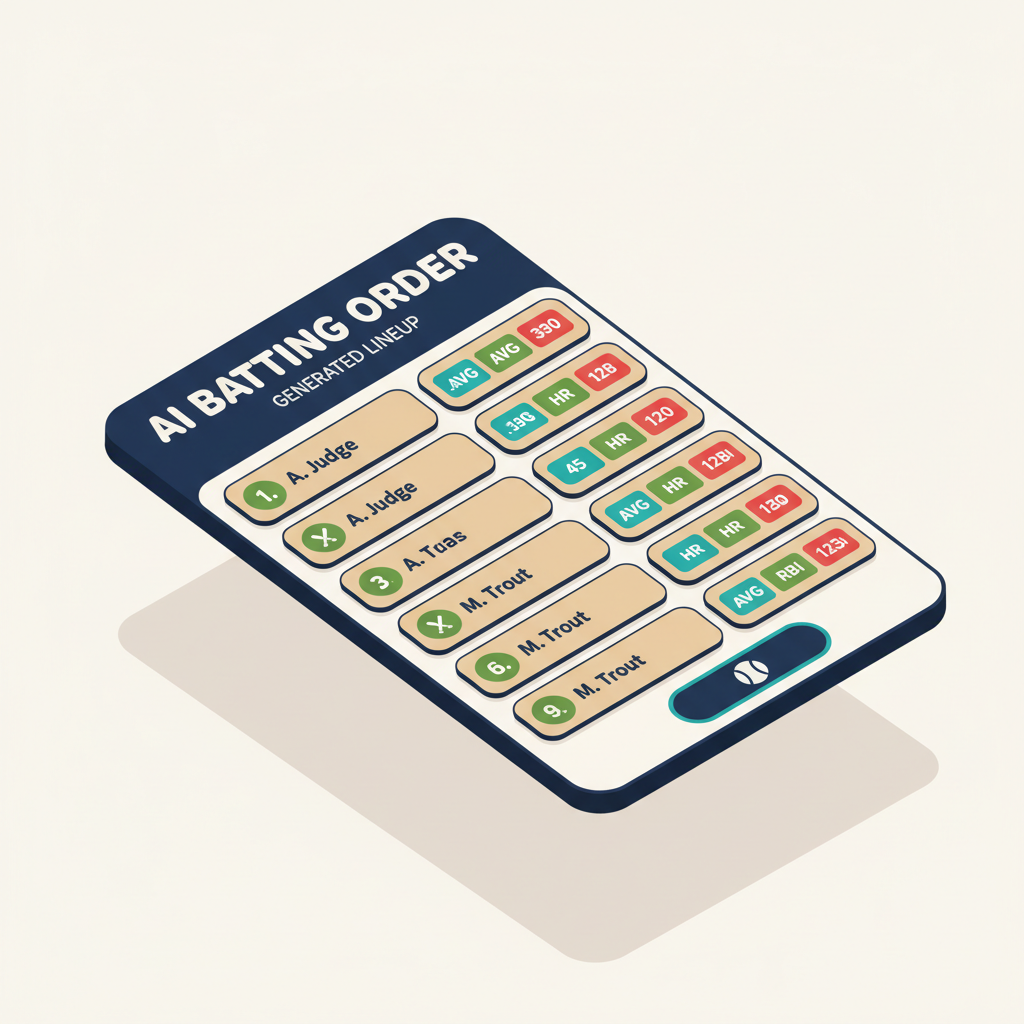
Rizzler's AI Batting Order, available on the Coach and Club plans, uses OPS as a primary input for lineup placement:
- High OBP, moderate SLG (high OPS) → Top of the order. These players get on base and set the table.
- High SLG, moderate OBP (high OPS) → Middle of the order. These players drive in runs with extra-base hits.
- High OBP and high SLG (highest OPS) → Your best hitter. Bat them where they'll see the most at-bats with runners on base.
The traditional "best hitter bats third" approach is less precise than using OPS to determine where each player's offensive profile fits. More on lineup philosophy
OPS Limitations
OPS isn't flawless. It weighs OBP and SLG equally, but many analysts weight OBP more heavily when it comes to producing runs. A player with .400 OBP / .350 SLG (.750 OPS) is often more valuable than one with .320 OBP / .430 SLG (.750 OPS): same OPS, but the first player's on-base ability matters more.
At the youth level, this nuance rarely changes coaching decisions. OPS is good enough for identifying your best offensive players and building a lineup around them.
Frequently Asked Questions
What does OPS stand for?
On-Base Plus Slugging. It is on-base percentage (OBP) added to slugging percentage (SLG), so a player with a .390 OBP and a .480 SLG has an .870 OPS.
What is a good OPS in baseball?
In MLB, .700-.720 is about league average, .800 is a good everyday player, .900 is all-star level, and 1.000+ is an MVP-caliber season. At youth levels, treat .750 as solid and .900+ as elite for the age group.
When should I start looking at OPS for my players?
OPS becomes useful around 12U when players have enough plate appearances for meaningful stats and the competition level is consistent enough for stats to be reliable. Before 12U, focus on OBP and quality at-bats.
Is OPS better than batting average?
For measuring overall offensive value, yes. A player with a .280 AVG and .830 OPS is almost always more valuable offensively than a player with a .310 AVG and .700 OPS.
Does Rizzler calculate OPS automatically?
Yes. Score games in Rizzler on any plan and OPS is calculated automatically for every player. On the Coach and Club plans, you can also import stats from GameChanger or a CSV file, and the AI Batting Order uses OPS to build lineups.
Stop doing lineup math by hand. Score your games and OPS builds itself.
Rolling stats out across a club or league? Our team can help.
Talk to our team
Want to spend more time coaching and less time with paperwork? Let's talk.
Tell us about your team and we'll show you how to plan games, set lineups, run the schedule, and develop players in one place, so you spend the season coaching instead of chasing admin.
Less admin, more coaching
Plan games, set lineups, and track the season in one place
Keep every family in the loop automatically
Tell us about your program
4 fields · takes 30 seconds
Lands in the same inbox as the Help button · human response only
Read Next
Is My Team's Data Secure in Rizzler?
FAQAI Batting Order: Build Statistically Optimized Lineups in Seconds
FeaturesSports Team Communication App: RSVP, Alerts, and Reports
FeaturesWhat Is a DS in Volleyball? The Defensive Specialist, Explained
VolleyballHow to Run a Water Polo Tryout: A Coach's Step-by-Step Guide
LearnFree Coaching Templates: Lineup Cards, Eval Forms & More
Resources