Rizzler Sports Logo
PricingFree Practice Planner
Basketball

Youth Basketball Practice Plans (Grades 3-6 and K-2)
A youth basketball practice plan is a 60-minute session in which every player has a ball for at least 40 of those minutes, every block is a game with a rule rather than a drill with a line, and the scrimmage at the end is small-sided on a rim the players can actually reach. The two plans below are complete: one for grades 3-6, where real skill instruction begins and where most rec and travel rosters sit, and one for grades K-2, the youngest division, where the goal is to make the ball feel like a friend. Both are built from the curated modules in the free basketball practice planner, so either can be opened there, shortened, reordered, and printed as a coach sheet.
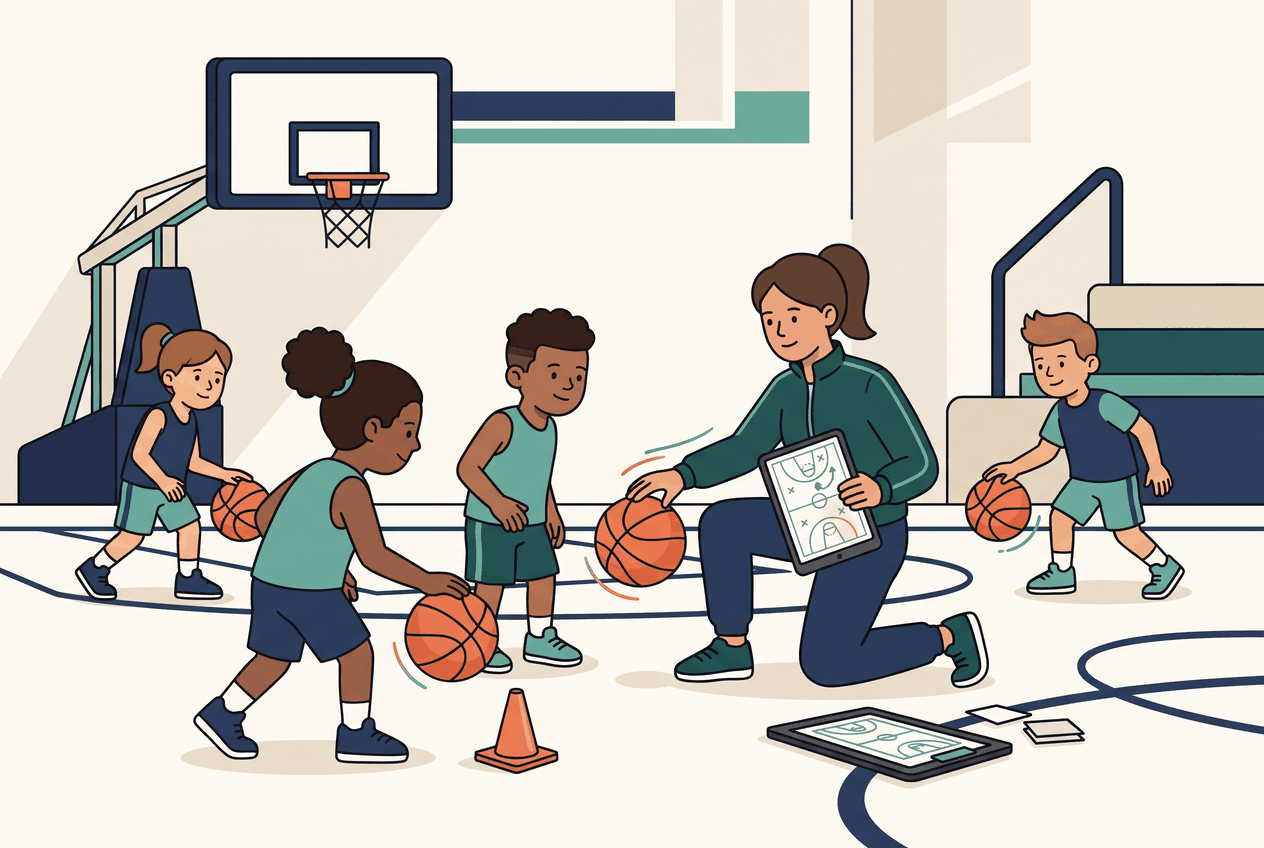
Young basketball players each dribbling their own ball on a gym floor while a coach kneels to demonstrate a crossover

What a Youth Basketball Practice Should Look Like

A youth practice should look like organized chaos: multiple balls, small groups at every basket, short blocks, and a coach who is demonstrating rather than lecturing. The measure of a good youth practice is not whether the team ran the drill correctly but how many dribbles, passes, and shots each player took, and how many of them happened with a defender nearby. A nine-year-old who takes 150 game-like touches in an hour is developing; the same player standing fourth in line for a layup drill is not.
Three rules make that happen. A ball for every player, so nobody waits for a turn. No line longer than four; if the group is bigger, split the drill across two baskets or run two drills at once. And every block under twelve minutes, because attention at this age runs out before the drill does. The coach's job is to keep the rotation moving and to teach one thing per block with a demonstration, not a speech.

Youth Basketball Practice Plan for Grades 3-6 (60 Minutes)

By third grade real instruction starts: the same 60 minutes now carries a genuine ball handling block, form shooting with a guide hand, and a scrimmage rule that quietly teaches passing.
Basketball practice plan · 9-12 (3rd-6th grade, 8U-12U)

Youth Basketball Practice Plan (60 Minutes, Grades 3-6)

60 min · 6 segments

  1. 0:00

    8 min

    Dribble Tag Zone

    Everyone dribbles inside a zone and tries to tag others while protecting their own ball; scales to any headcount.

    Arrival
  2. 0:08

    8 min

    Dynamic Warm-Up Baseline Lines

    Baseline-to-baseline dynamic movement series that ends with defensive slides and closeouts, ball-free.

    Warm-Up
  3. 0:16

    12 min

    Ball Handling Circuit

    Four-station handle circuit: stationary two-ball, cone weave, change-of-direction moves and full-speed finishing.

    Core
  4. 0:28

    12 min

    Form Shooting Progression

    Close-range form shots that step out to game spots, every player shooting or rebounding, tracked by makes.

    Core
  5. 0:40

    14 min

    3v3 Scrimmage: Score Off a Pass

    Reduced-numbers scrimmage with a single constraint so every player gets maximum touches and decisions.

    Core
    Universal
  6. 0:54

    6 min

    Huddle: Wins & One Thing

    Two-minute huddle: each player names a win and one thing to fix, coach previews the next practice.

    Cooldown

Equipment: basketballs (1 per player), 4-8 cones, none (cones optional), basketballs (1-2 per player), 12-16 cones, chairs optional, basketballs (1 per 2 players), tape or cones, sport balls, cones or boundary markers, pinnies, none

Change the length, swap modules for your age group, print a one-page coach sheet, and share it by link. No login.

Customize this plan free →Save to my account
The circuit adds movement, with a crossover at each cone and a change of speed on the whistle. Form shooting progresses from one hand to the guide hand and from three feet to the block, and the coaching point is still the wrist finish rather than the make. The 3v3 scrimmage counts a basket only when the shot comes off a pass, which produces more passing in twelve minutes than any drill will; rotate groups every three minutes so every player plays as much as they sit. The huddle names one win per player and one thing to work on, and it ends on time, because a 60-minute practice that runs to 70 has taught the parents that the schedule is a suggestion.

Youth Basketball Practice Plan for Grades K-2 (60 Minutes)

If you are coaching the youngest division, first and second graders, the plan is built around fun with a purpose: every block is a game, the rim is lowered to eight feet if the gym allows it, and the scrimmage has a no-steals rule so the players who can dribble get to keep dribbling.
Basketball practice plan · 6-8 (K-2nd grade)

Youth Basketball Practice Plan (60 Minutes, Grades K-2)

60 min · 6 segments

  1. 0:00

    8 min

    Dribble Tag Zone

    Everyone dribbles inside a zone and tries to tag others while protecting their own ball; scales to any headcount.

    Arrival
  2. 0:08

    6 min

    Partner Mirror Warm-Up

    Pairs mirror each other's movements in small boxes — footwork, reaction, and laughs while heart rates climb.

    Warm-Up
    Universal
  3. 0:14

    12 min

    Ball Handling Circuit (Stationary First)

    Four-station handle circuit: stationary two-ball, cone weave, change-of-direction moves and full-speed finishing.

    Core
  4. 0:26

    10 min

    Form Shooting on Lowered Rims

    Close-range form shots that step out to game spots, every player shooting or rebounding, tracked by makes.

    Core
  5. 0:36

    12 min

    Captain's Choice Game Block

    An earned, player-chosen small-sided game block — the engagement reward that keeps kids coming back.

    Core
    Universal
  6. 0:48

    12 min

    3v3 Scrimmage, No Steals Off the Dribble

    Reduced-numbers scrimmage with a single constraint so every player gets maximum touches and decisions.

    Core
    Universal

Equipment: basketballs (1 per player), 4-8 cones, cones, basketballs (1-2 per player), 12-16 cones, chairs optional, basketballs (1 per 2 players), tape or cones, sport balls, pinnies, cones or boundary markers

Change the length, swap modules for your age group, print a one-page coach sheet, and share it by link. No login.

Customize this plan free →Save to my account
Dribble Tag opens the practice with everyone moving and dribbling without being told to dribble. The partner mirror warm-up is short because six-year-olds do not need a hip-mobility routine; they need to move. The ball handling circuit stays stationary at first: pound dribbles, crossovers, and figure-eights standing still, because the ball leaves the moment the feet start moving, and movement gets added only for the players who keep it. Form shooting happens from three feet on the lowered rim with one hand, and nobody shoots from beyond the block; a seven-year-old heaving from the elbow on a ten-foot rim learns a two-handed push shot that takes years to unlearn. Captain's Choice lets the players pick the game, which is the block they will remember. The 3v3 scrimmage bans steals off the dribble, so the game stays a game instead of a chase.

Ready to take your game to the next level?

What to Skip Below Sixth Grade

Skip laps, full-court 5v5, set plays, zone defense, and any block that puts more than four players in a line. Laps teach nothing about basketball and use up the minutes when players are freshest. Full-court 5v5 at this age is two players dribbling while eight watch; 3v3 on a half court gives everyone three times the touches. Set plays are memorization, not skill, and they fall apart the moment a defender does something unexpected, which at this age is every possession. Zone defense wins games in fifth grade and produces players who cannot guard anyone in ninth.
Also skip the ten-minute talk. A demonstration takes 20 seconds; a speech takes the block. If the players need a concept explained, explain it while they are dribbling.

Grade-Band Guidance: K-2, 3-4, 5-6

Kindergarten through second grade is about the ball feeling comfortable in both hands and a shot that starts with the right form on a rim the player can reach; keep every block a game and expect nothing tactical. Third and fourth grade is when the ball handling circuit, form shooting with a guide hand, and a scrimmage rule become the core of the practice; players can now hold one teaching point for a whole block. Fifth and sixth grade adds the first team concepts: help defense as a shape rather than a scheme, the 3-man weave as a passing-on-the-move drill, and box-out battles before rebounding matters in games. The free planner filters the module library by grade level, so a K-2 plan only shows modules built for that age.

Build and Print Your Youth Practice Plan

Open either plan above in the free basketball practice planner with the "Customize this plan" button, adjust the length to your gym slot, swap in a different module from the library, and print the one-page coach sheet. It needs no login. The basketball practice plan template is the same session sheet as a blank PDF and Excel file for coaches who plan by hand. When you want the plan attached to a practice on the team calendar with RSVP counts and the equipment list built from the drills, save it to a free Rizzler account and it lands in Practice Manager.
For the coaching side of a youth season, how to coach youth basketball covers playing time, parents, and the first-year mistakes, and Rizzler Reps gives players at-home ball handling reps between practices.

Frequently Asked Questions

How long should a youth basketball practice be?

Sixty minutes for grades 3-6, and no more than that for K-2. Attention runs out at about an hour regardless of the plan, and a 60-minute practice with a ball in every hand produces more development than a 90-minute practice with lines. Teams that have a 90-minute gym slot should use the extra time for free play at the baskets, not more drills.

What drills are best for a youth basketball practice?

Stationary and moving ball handling circuits, form shooting from three feet on a lowered rim, dribble tag, partner passing, and small-sided 3v3 with a rule that rewards the skill of the night. The best drill for a youth player is any drill that keeps a ball in their hands and a defender nearby.

How many players should be in a scrimmage at this age?

Three on three on a half court. Every player touches the ball, every player has to guard someone, and the decisions are simple enough to make. Full-court 5v5 should wait until middle school.

Should youth basketball practices include conditioning?

Not as a separate block. Dribble tag, a moving ball handling circuit, and a 3v3 scrimmage with rotations every three minutes condition a nine-year-old more than laps do, and they teach basketball at the same time.

Can I print these youth basketball practice plans?

Yes. Open either plan in the free basketball practice planner and print the one-page coach sheet with the time column, every block, the coaching points, and the equipment list. No account is needed.