Resources
Skills Assessment Form (Printable Template)
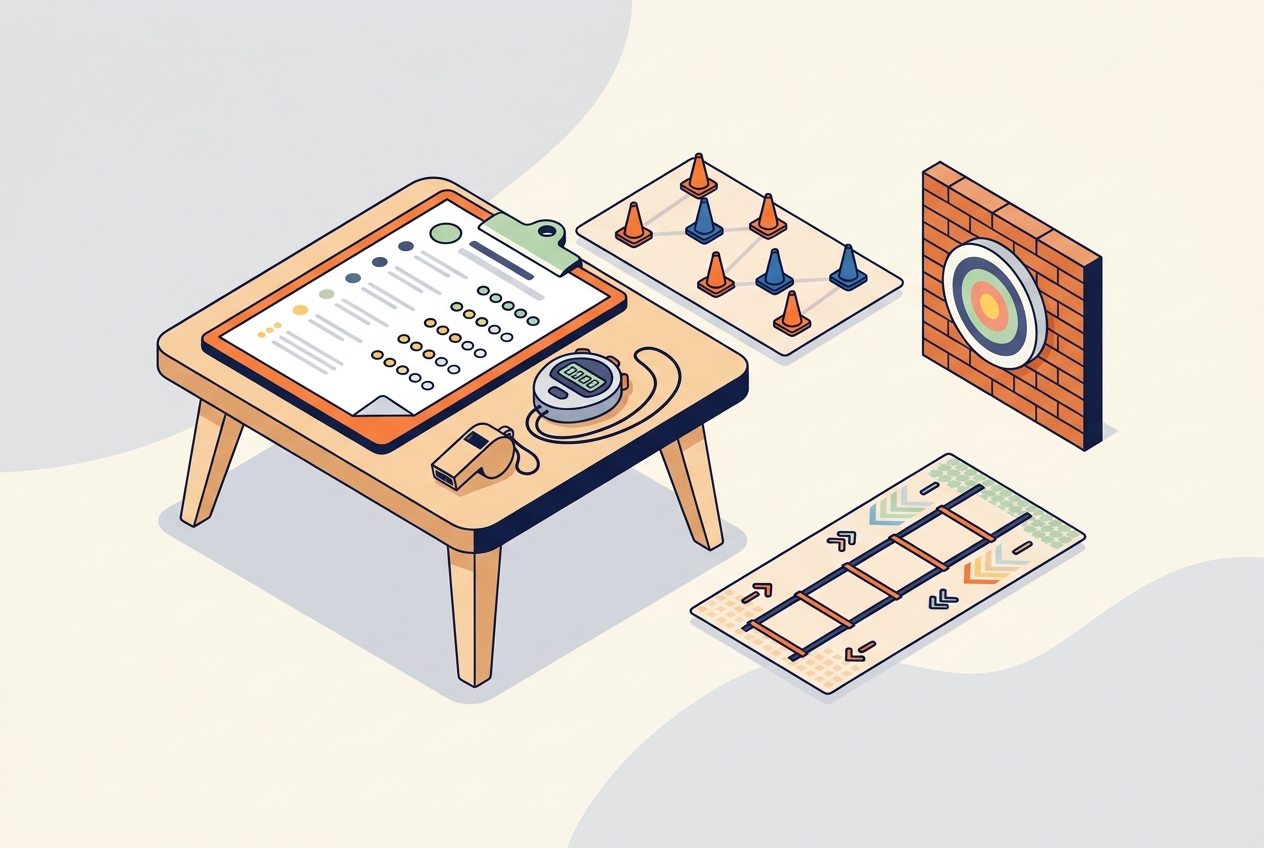
A skills assessment form is a station-based scoring sheet: each row is one skill tested at one station, scored 1 to 5 under the same conditions for every player, with a notes column for what the number misses. It is the most objective of the evaluation forms because every player attempts the same task the same number of times. The full template is below, ready to copy for any sport, with a printable version available by email at the bottom of the page.
What Is a Skills Assessment Form?
A skills assessment form measures isolated skills under controlled, repeatable conditions, which makes it different from its two siblings. A tryout evaluation form mixes drills and live play to make a selection decision; a player evaluation form captures a coach's judgment of a rostered player over time. A skills assessment strips the judgment down: same station, same reps, same scoring anchor for everyone, so two players' scores are directly comparable.
That makes it the right tool for three jobs: baselining a new group at the first practice of the year, measuring a specific skill before and after a training block, and adding an objective layer to tryouts or placement days where you expect roster decisions to be questioned.
The Scoring Scale
Because stations are controlled, you can anchor scores to observable outcomes rather than general impressions. Define the anchors per station before players arrive; the table below is the general frame.
| Score | What it means at a station |
|---|---|
| 1 | Cannot complete the task at this age group's standard |
| 2 | Completes inconsistently; technique breaks down |
| 3 | Completes reliably at age-group standard |
| 4 | Completes at speed with consistent technique |
| 5 | Completes at speed under pressure; top of the age group |
The Skills Assessment Form Template
Print one form per player. Each player gets the same number of attempts at each station; score the body of work, not the best rep, and note anything the score hides.
Player name / number: ______ Assessor: ______ Date: ______
| Station / skill | What to measure | 1 | 2 | 3 | 4 | 5 | Notes |
|---|---|---|---|---|---|---|---|
| Sprint speed | Timed sprint over a set distance | ||||||
| Agility | Timed shuttle or cone pattern | ||||||
| Core skill 1: control | Repetitions of your sport's central skill in a set time or count | ||||||
| Core skill 2: accuracy | Attempts at a target; count makes out of total | ||||||
| Core skill 3: receiving | Clean receptions, catches, or fielded balls out of total | ||||||
| Core skill 4: position skill | The skill specific to the player's position or role | ||||||
| Conditioning | Timed run or interval appropriate to the age group | ||||||
| Live application | Short small-sided play; does the skill hold up |
Total (out of 40): ______ Best station: ______ Weakest station: ______
Rename the four core skill rows for your sport before printing: for basketball that might be ball handling, shooting, rebounding, and defensive slides; for soccer, first touch, passing, dribbling, and finishing; for baseball or softball, fielding, throwing accuracy, hitting, and position work. Speed, agility, conditioning, and live application stay the same for every sport.
How to Set Up Stations That Produce Fair Scores
Keep one assessor per station for the whole session, define the task tightly, and give every player identical attempts. Fairness comes from the setup, not the scorer: if the sprint distance changes between groups or one line gets tired players and another gets fresh ones, the scores stop being comparable and the whole exercise loses its authority.
Run the live application station last. Isolated skills tell you what a player can do; the small-sided station tells you whether it survives contact with a game. When a player scores 4s at every technical station and a 2 in live play, that gap is the single most useful note on the form, and it is the reason this form pairs well with a full selection process built on the tryout evaluation form.
Get the Printable Version by Email
The template above is free to copy from this page. For the print-ready version for your assessors, fill in your details below, mention skills assessment form in the message box, and we will email it to you.
Talk to our team
Want to see how to develop players all season long? Let's talk.
Tell us about your team and we'll show you how season-long skill tracking becomes the progress report a parent opens, while players keep building between practices with Rizzler Reps.
Track skills all season, not just on tryout day
Turn evaluations into reports parents actually open
Players build habits between practices with Rizzler Reps
Tell us about your program
4 fields · takes 30 seconds
Lands in the same inbox as the Help button · human response only
The Digital Version: Player Skill Assessments in Rizzler
This form is the manual version of Rizzler's Player Skill Assessments, where each assessor scores their station from a phone, results total automatically, and repeat assessments across the season sit side by side so you can see what a training block actually changed. Rizzler also produces Player Skill Reports to share with parents and players, and the same engine powers the team tryouts feature when the assessment is part of a selection day. Clubs running large placement events can see the end-to-end flow at Rizzler for team tryouts.
Frequently Asked Questions
How many stations should a skills assessment have?
Six to eight, taking three to five minutes per player each. Fewer than five and you are not sampling enough skills to say anything useful; more than nine and the session runs long, players tire, and late-station scores measure fatigue instead of skill.
How many attempts should each player get per station?
Three to five scored attempts after one unscored practice rep. The practice rep removes the "what am I supposed to do" penalty, and scoring several attempts rewards consistency instead of luck.
What is the difference between a skills assessment and a tryout?
A skills assessment measures isolated skills under identical conditions and can happen any time in the year; a tryout is a selection event that combines skill measurement with live play, rankings, and roster decisions. Many programs run this skills assessment as the first half of a tryout day, then add scrimmage evaluation on top.
How often should I repeat a skills assessment?
Two or three times a season: a baseline at the start, an optional midpoint, and an end of season repeat. Pair the final one with the end of season evaluation form so the objective station scores and the coach's judgment land in the same conversation.
Read Next
How to Coach Youth Soccer: A First-Season Guide
LearnRizzler for Travel Ball Assistant Coaches
For CoachesBatting Average (AVG): Definition, Formula & Youth Baseball Context
StatsLibero Rotation Rules: How the Libero Fits the Wheel
VolleyballFootball Tryout Evaluation Form: What to Score (Free Template)
LearnHow to Run a Basketball Tryout: A Coach's Step-by-Step Guide
Learn